
The Census Bureau thinks so. They are calling Norfolk the fastest shrinking city in the America. If Norfolk is shrinking, we should see properties sitting vacant. But we don’t. We should see building permit application decline. But we don’t. It seems the problem is with the way that the Census Bureau calculates the numbers:
The Census Bureau adds births, subtracts deaths and adds migration into and subtracts it out of cities.
The University of Virginia’s Weldon Cooper Center for Public Service also calculates population estimates. Their forumla includes more variables:
U.Va. looks at building permits, people per household, vacancy rates, school enrollment, births, state tax returns, and mobile home counts.
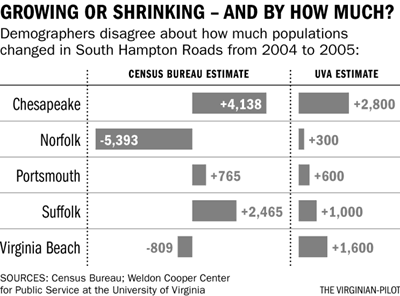 As the result, the UVA numbers are significantly different from those of the Census Bureau. We won’t know for sure until the real census is done in 2010. In the meantime, I tend to believe the UVA figures. As I drive around town, I see new properties being built on every available piece of land. In an open space next to my office building, I see four new homes going up. Across the street, three new homes have replaced a few smaller, older homes. Both of these mini-projects are in a neighborhood that has seen little new home building in the last 20 years. Land has become a premium in Norfolk, forcing builders to look to build properties in neighborhoods that they previously bypassed. If the population of Norfolk were shrinking, there would be no need for these homes.
Sounds like to me the Census Bureau screwed up on this one.
 VIVIAN J. PAIGE | All Politics is Local
One thing I know from my time at the Census Bureau is that the military presence in Norfolk has some very strange effects on the numbers. Of the 234,000 people counted in 2000, 14,500 lived in “military ships group quarters”. These were sailors on ships based at Norfolk that were either in port on Census Day or out on local sea exercises, and who didn’t have local off-base addresses. (The census doesn’t count people by legal residence, but by phyiscal residence.)
In theory, when the ship deploys overseas, these sailors become part of the overseas military population and would not be considered as living in Norfolk. I’m not sure exactly how that factors into current population estimates (I never worked on those), but I do know that they get overseas manpower counts from the Department of Defense and factor those changes into their migration numbers. They don’t do this on a real-time basis, but if they did, a carrier group deployment or arrival could change the city’s census population by a thousand people or more overnight.
The Navy’s increased optempo since 9/11 has had a slight depressing effect on Norfolk’s population (and neighboring cities, as well.) That’s not the issue here though. The problem is that it’s in the nature of the way the fleet is counted that the numbers can bounce up and down.
The other part of the problem, of course, is that the current census numbers (and Weldon Cooper’s, for that matter) are statistical estimates, and all statistical estimates should have error estimates attached to them, just like poll results. Without those, it’s hard to say just how meaningful the numbers are.
From the original article:
“Fraim said he wondered if the federal government changed how it classified military personnel as residents. Robert Bernstein, a spokesman for the Census Bureau, said he does not believe any such changes were made.”
So maybe not the military. You are correct about the error estimates. Neither of them (CB or UVA) released that info.
I think that both sets of data are wrong. Just recently the city of Norfolk has torn down two large public ousing communities. Plus its destruction of many low income multiple family houses to make way for single family (single individual) homes has displaced thousands of poor and mostly Black people. The Census Bureau admits that it cannot effectively count people on large or moderate size urban areas like Norfolk because of the transient nature of so many poor, Black, white, homeless and displaced individuals and families, especially African American males, many of whom go from house to house, or jail to jail, uncounted. These are people that a spokesman for the Virginia’s Weldon Cooper Center for Public Service says cities do not want to count. They are not counted until the city is seeking data to apply for some big grant using poverty figures. Let’s just wait until 2010 and get at least a resonable good accounting.