
From today’s Virginian-Pilot:
The ability of incumbents to raise – and spend – money makes it easier for them to stay in office, said Deborah Goldberg, an attorney and ethics expert who follows campaign-finance reform issues for the Brennan Center for Justice at New York University School of Law.
“It’s easy for an incumbent to swamp competition,” she said. “The system is set up to make this sort of thing happen.”
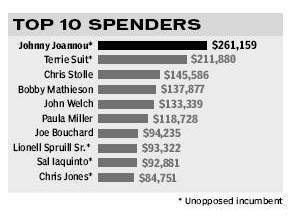
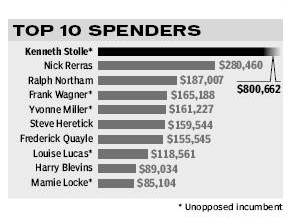
You can say that again. Of course, guess who set up the system? Why, that would be the incumbents!
One would expect that the top spenders in the Southside Hampton Roads races would be candidates in contested races. Leading the pack for Senate is Ken Stolle, who has spent over $800,000 in this election cycle, which began for Senators 1/1/2004. The top spender on the House side is Portsmouth Delegate Johnny Joannou. Yes, he is currently unopposed but Joannou’s spending came about as the result of a contested primary in June. Taking him out of the mix, the top spender is Terrie Suit, who has spent nearly $212,000 since 1/1/2006. Both Stolle and Suit are running virtually unopposed. (I say “virtually” because there is a write-in campaign going on in both of these races.)
This is why it costs so much to run for office. And the amount of money necessary will only increase, further limiting the pool of candidates.
We get the democracy we can afford, folks.
 VIVIAN J. PAIGE | All Politics is Local
The absolute amounts are less concerning to me than what it’s being spent on. Sure, it costs a lot to advertise and run a campaign, but paying rent to your own firm (where a share of that money will end up back in your personal pocket), hiring relatives (I’m sure *that’s* a competitive market), and holding unnecessary blowout as political favors? No thanks. Between this and the ridiculous amounts paid to federal campaign media consultants (see the recent story about the Guiliani campaign’s high style – tho’ its certainly not limited to him), I’m less and less likely to make political contributions these days, unless I *really* believe in the candidate (and even then, I wonder whether I’m doing the right thing). I’m not interested in perpetuating the system.
In Virginia, we have a long-standing tradition of the rich lording over the rest of us. This current election system is another way for the landed gentry to maintain control and to keep the poor down. Oh, the rich may not be intentionally out to screw the poor, as much as they are out to serve their self-interests, but the outcome is still the same. Those who have, have, those who don’t, rarely are able to rise.
There have been volumes written on campaign reform, but until the People demand change, we can only expect things to get worse.
Voters should demand an end to corporate contributions to Virginia campaigns. There should be a limit to the amount the candidate can contribute to their own campaign, including “loans.” Campaign contributions should be limited to only $500 per registered voter and those voters must be registered in the candidate’s district. We should also limit the campaign season to three months.
One source of hope that change may occur is the recent success of the Ron Paul campaign. The People are getting behind his campaign and using new media such as Youtube and blogs, to spread the word about his Constitution-based philosophy of governance. Ron Paul’s use of new media and his decentralized campaign model where thousands of people contribute content, has the potential to restore real power to the citizens. Of course, it helps that Ron Paul is a very intelligent and sincere candidate, who has a lifelong record of fighting to restore our government to its Constitutional limits.
Oh, lord, they’re *everywhere*. But at least it was relevant.
Which is not to say that there’s any value in any of the suggested reforms. It’s a bit rich to see someone who presumably has libertarian leanings (thus the Ron Paul support) advocating an extreme level of government regulation of speech.
I once again find myself in agreement with MB. While “Ron Paul [may be] a very intelligent and sincere candidate, who has a lifelong record of fighting to restore our government to its Constitutional limits,” there isn’t a single line in the Constitution of the United States that grants the Federal Government the authority to tell you what you can’t do with your own money.
Have you looked at John McCain’s candidacy? He’s all about telling you what you can’t spend money on in politics.
There are many things the government does that the constitution does not give it the power to do, and the Supremes find some tortured logic to declare them constitutional.
It is very easy to sit and throw stones about these issues. While many of the ideas have merit, I also hear people say they don’t know the candidates issues, that is why they don’t vote. How do you get your message out, well, it takes money. Thanks to the new resourses like Youtube, you are able to hear the message of less known candidates. As far as campaign expenses, bottom line, if you don’t like how a candidates or elected official spends their money, don’t contribute. But don’t assume that all candidates and elected officials are rich or in the financial upper class.
But really, when someone says that they don’t know a candidate’s issues/positions, is it because: 1) the candidate failed to spend enough money to make that position/issue accessible to the person, or 2) that person is just too ()*#@$ lazy to read a newspaper or visit a website?
MB doesn’t get it. Putting an end to corporate buying of Delegates and Supervisors in Virginia is not limiting speech. Capping the donations and limiting those donations to only include citizens who are registered in that specific district does not limit speech. Shortening the campaign season to some sane level, such as three months does not limit speech. Reforming the process to neutralize the big boy’s fat wallets will enhance the free exchange of ideas, because more citizens of good character will be able to mount viable challenges to those who now are in place due mostly to corporate sponsorship. Spending does not equal speech.
MB, I noticed that you offered no ideas of your own. Typical!
As for addressing the voter apathy issue, I would rather NOT have uninformed people going to the polls. That is how Minnesota got Jesse Ventura elected as Governor and New York got Billary in the Senate.
One novel idea was suggested by J Tyler Ballance a while back and discussed on Bearing Drift or one of the other conservative blogs. The concept was that the Lottery Commission would sponsor a Million Dollar election day lottery and every person who voted would get a pre-printed lottery number. After the polls closed, the winning lottery number would be announced.
Ballance’s idea is creative. Although, I think it would initially attract a lot of those more interested in a free shot at a big lottery than good government, if the lottery was kept up for several election cycles, then even the lottery bubbas might actually start to take an interest in the merits of the candidates.
“Spending does not equal speech.” Unfortunately, the courts have disagreed with you.
One of the problems I see with the ideas offered here is this – I think limits hurt challengers. Those in power will always raise enough money to compete. Limit it, and it will find a way. Stop corporate contributions, and it will find a way. That’s just reality.
In Virginia, Mark Warner can write someone a 5 or 6 figure check, and no one on this blog will complain. Should Mark be stopped?
You can stop corporate contributions when you make it come from the pockets of individuals (and yes, this argument cuts across the spectrum).
But I’m not advocating that. Nor am I advocating stopping the self funding of campaigns. If you want to waste your money on a vanity candidacy, have at it. Your opponents will certainly let everyone know (as they are with Romney) that your bank account doesn’t mean you’re popular – you’re just generous with yourself. I don’t think Mark Warner would need to worry about that particular charge.
As to the problem of a challenger facing a self financing incumbent – well, that’s where public financing should come in. The solution to offensive speech isn’t to restrict it – it’s more speech.
C.L., one fundamental flaw in your reasoning is the notion that all political speech or spending is made through political campaigns. It’s not; and in fact, the more restrictions we see placed on campaign finance, the more money shifts to independent advocacy groups, 527s and issue messaging. In politics, money is like water: it follows the path of least resistance. If I can’t give money to a political candidate, I can give it instead to an organization that can buy television time explaining how his opponent is a child molester. Campaign finance “reform” is what gave us swiftboating and red handed television ads. It funnels money towards negative advertising and makes the system even more intollerable than it already was to begin with. Meanwhile, there’s not less money in the system as a result–there’s more.
Actually, I am a Republican, and I would have no problem with Mark Warner’s giving money to whomever he please. However, only individuals, people, should have that right. Corporations, unions, PACs, etc., should be barred from contributing to campaigns at all. They can encourage their members to contribute, but they cannot do so themselves (under the Anon E. Mouse Campaign Finance Reform Law).
MB, public financing = restrictions. True in politics, and true in anything else government funds. At some point, you run out and then what? Hope the reporter writes you a nice story?
I really don’t want to walk further down the path of having government tell us how much political speech is enough. Public financing of campaigns would be a wreck. Your tax money would fund candidates you oppose.
All you need do is look beyond our borders to see that other countries have succeeded at reforming their political process by mandating a shortened, fixed campaign season. Limiting contributions to only those inside the district who are registered to vote would also go a long way toward ending our current corrupt system.
Of course, I expect those who make a living off of politics, the media, the “rented strangers” (consultants) and self anointed pundits, all of whom benefit from long, expensive, campaigns to squawk the loudest while waving in the air the red herring of the demise of, “Free Speech.” What a bunch of crap.
Also, nobody here is advocating for government financing of campaigns, so don’t go there. We can make some positive changes to our system by getting the corporate “Big Boys” out of the process and by limiting donors to only those registered in the District. Limiting the campaign season will also help limit the influence of third party advertising.
To advocate no action at all merely means that those for the status quo support the current, corrupt regime. I, like many Virginians, know that we need reform, we need change to a more responsive system of government. This November, THROW THE BUMS OUT!
Clairese, there was a direct mention of public financing in comment 10, so that’s what I was responding to.
I just got a robocall bashing Thelma Drake, so what would you like to do? Limit Thelma Drake from responding while any private group can hit the phones, the air, or the newspaper?
As uncomfortable as it may be for some, the first amendment protects anyone, even politicians, to speak. I’m not about to change that so our politics can be more like it is “beyond our borders.”