
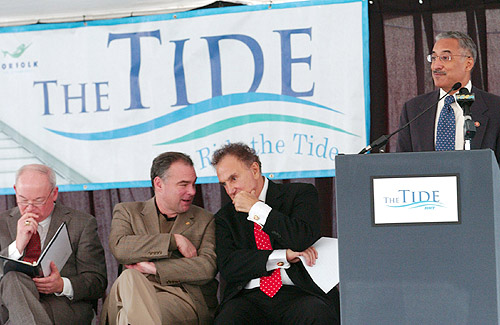
 The groundbreaking for Norfolk’s Light Rail project took place Saturday. Elected officials from the federal level on down participated in the event. The project has been a long time coming and Norfolk is to be commended for relentlessly pursuing the federal funding necessary to accomplish this, especially in light of the surrounding cities’ unwillingness to participate.
But the editorial board of the Virginian Pilot, while applauding on its efforts, points out some problems with the process, problems that need to be corrected.
Norfolk needed a smart plan five years ago when it got serious about light rail. It needed a smart plan three years ago when the federal government got serious about Norfolk light rail. It needed a smart plan in October, when The Tide was finally approved.
Today, as it breaks ground on one of the most important projects in its history, Norfolk still needs one.
As it turns out, I was recently given a report on recommendations for the Hampton Roads Metropolitan Planning Organization (pdf). The report, which is a hard read for those without any background in MPOs (such as myself), indicates that the HRMPO really needs significant reforms if it is to be successful in meeting the transportation needs of Hampton Roads. The addition of the new Hampton Roads Transportation Authority to the mix will not solve the overall problems of the HRMPO.
Comprehensive regional planning is not an option, folks.
 VIVIAN J. PAIGE | All Politics is Local
I talked to some from the Center for Smarter Growth who told me professionals were here and told Norfolk of the zoning problem in (drum roll, please) 2001.
Norfolk has had 6 years to fix the problem. Heads should roll.
Oops…Coalition for Smarter Growth. They sent a speaker to a meeting in Virginia Beach in October.
BTW, Virginia Beach rezoned it’s portion of the Norfolk Southern ROW 4 years ago.
I figured you’d showed up when I posted this 😉 By the way, have you read that MPO report linked to above?
I started to read it. Not only is it “a hard read”, but I put little stock in FHR.
Okay, I browsed through it for your enjoyment. My biggest dispute with it is their proposed structure for Transportation Advisory Committees (TACs). I believe you could do it with five TACs: Business TAC, Freight Movement TAC, Mass Transit TAC, Primary Roads TAC and Secondary Roads TAC.
Sitting on HRT’s User Citizen Advisory Committee, let me toss out what I might do with the Mass Transit TAC: two TDCHR reps, two UCAC reps, two PTAHR (Public Transportation Alliance of Hampton Roads) reps, three local government reps, a General Assembly rep, and a DRPT (Department of Rail and Public Transportation) rep.
Agree, your list of TACs is excellent. You could also add a Citizen’s TAC (almost standard around the country and a good place to start) and also add a Safety TAC. Your membership for the Mass Transit TAC looks perfect. The report, in my opinion, is not a hard read. Transportation is an extraordinarily complex, massive, and sometimes arcane subject, a major challenge for anyone. That is why this report is so long. That is why the report addresses so many unexpected Chapters and articles (legal, budgets, fiscal constraint, transit, training, freight, state level factors, ports, etc.). But, for Hampton Roads, opportunity knocks if we can find the time and will to do the hard work.