
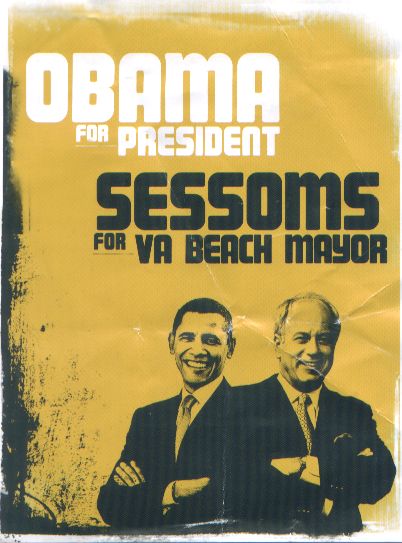
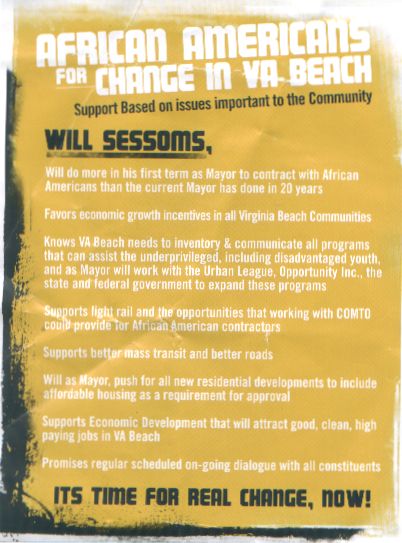
 The Oberndorf campaign for mayor in Virginia Beach has filed a formal complaint in regards to the distribution of fliers showing now mayor-elect Will Sessoms and president-elect Obama.
Bruce Williams, a consultant who was hired to help the Sessoms campaign with black voters, said this week that he didn’t ask for permission to hand out the fliers.
“I’ve already gotten beaten up on this,” Williams said.
He said he didn’t know who had paid for the fliers. Somebody stopped him when he was checking on polling sites before the election and gave him the boxes containing the fliers, Williams said.
The fliers have provided fodder for bloggers and politicos in the weeks after the election.
It made Carlos Michael Segarra, a student at Norfolk State and a poll worker for Sessoms, uncomfortable. Segarra said he and a few of his fraternity brothers were recruited to work in black precincts.
Segarra said he handed out a few of those fliers on Election Day, but then, “we felt really weird and put them back in the car …. ”
Segarra said he received the fliers during a training session the night before the election at the Williams Mullen law firm in Town Center, where Sessoms supporter and former Councilman William Harrison is a partner.
Segarra said poll workers were given three fliers, including the Sessoms-Obama one, and instructed to give the flier to black voters.
And based on my analysis, those fliers cost Oberndorf the election.
From what I’ve been told, Commonwealth’s Attorney Harvey Bryant had a meeting with members of the Oberndorf campaign and several others. Bryant’s office has promised to look into the situation, and said if the evidence warranted it, he would ask for a special prosecutor to be named. Supposedly, there is some provision that would allow the perpetrator to be charged with a class 1 misdemeanor, which is said to carry jail time. (Anyone know of the section this case would fall under?)
We need to keep watching this, folks.
h/t spotter
 VIVIAN J. PAIGE | All Politics is Local
So, what was the “formal complaint?”
You’ll have to ask Bryant’s office about that. I was only made aware of the meeting.
Forgot one:
Of course, the State Board says a disclosure is not required by “An Individual who makes Independent Expenditures of less than $1,000 for a single candidate in a single election cycle”
And you know they spent less than $1,000 because….?
What makes you think these are independent expenditures? They came in boxes and were provided to paid campaign workers for Will Sessoms at Williams Mullen during a scheduled training.
I don’t know. But you have to print a lot of fliers to spend a thousand dollars.
I’m just remembering the first amendment about free speech and expecting those who want to throw the baby out with the bath water to be consistent.
If we convicted every politician who “misleads” in advertising, Obama will have a short tenure in the White House.
If they came from the candidate, which they almost certainly did since they were provided by paid campaign staff in boxes to paid campaign workers at a scheduled training at the Williams Mullen law firm, there is no “$1000 limit.” They were part of an organized candidate campaign that spent a lot more than that.
This is not a First Amendment issue. The campaign laws require whoever authorized and paid for this message to disclose that fact. It’s a valid time, place, and manner restriction that has been upheld by the courts.
The voters can judge whether they accept or reject the message. The law simply requires that they be informed who paid for it.
The requirement is intended to avoid sleazy scenes like Will Sessoms’ unconvincing denial that his campaign had anything to do with this. Like any candidate for public office, he can say what he wants, others can say what they want on his behalf, but under the law voters are entitled to know who said it.
That’s very different than trying to tell citizens what they can or cannot wear when they line up to vote for the candidates who seek the opportunity to serve them.
If the campaign paid for and authorized the flyer without Sessoms’ knowledge, the campaign is culpable.
But let’s get serious. It’s not the disclaimer that Oberndorf’s upset about. It’s the message. Vivian’s comments and Louisa Strayhorn’s quotes in the article say as much.
If Sessoms’ campaign forgot a disclaimer on some innocuous brochure (and believe me – that happens a lot…Scott Taylor), would there be all this attention?
The bottom line though is that at most a fine will be levied, but the election will not be voided.
Sessom’s campaign has plenty of money for fines, so the worst case penalty will still be insignificant as a deterrent to future misconduct.
The only real way to change things is for voters to reject any candidate running with a half million dollars of special interest money. Informed voters are the only real deterrent to this kind of chicanery.
Yes, it’s the message of the fliers, a message that was designed to imply that Sessoms supported Obama and vice versa, when that was NOT the case.
The law (written by politicians for the benefit of politicians) does not consider the effects of this and only looks at the technical aspects, in this case, the failure to provide a disclaimer. The law (written by politicians for the benefit of politicians) actually encourages bad behavior.
And Don, I agree that informed voters are the key. But as long as the MSM is in bed with the politicians, the average voter has one heck of a time sorting out truth from spin.
There are things that are illegal but not necessarily morally wrong.
There are things that are morally wrong but not necessarily illegal.
And there are things that are both morally wrong and illegal.
In this case, the flier is morally wrong because it’s deliberately misleading and inaccurate. It’s also illegal because it doesn’t disclose who authorized or paid for it.
Those are separate but interrelated concepts. No doubt the authors of this flier decided to violate the disclosure law because they didn’t want to be held accountable for its misleading, inaccurate message.
Yes, they have a First Amendment right to spread their misleading message. And Vivian and Louisa Strayhorn and Meyera Oberndorf have a First Amendment right to point out that it is misleading and wrong.
And the public has a right to expect that the disclosure law will be enforced, regardless of the content of this sleazy little tract.
And hopefully the voters will remember this and hold Will Sessoms accountable for his campaign’s sleazeball behavior.
What? One flyer threw the election? If the voters voted based on a single flyer perhaps they should not have been voting in the first place.