
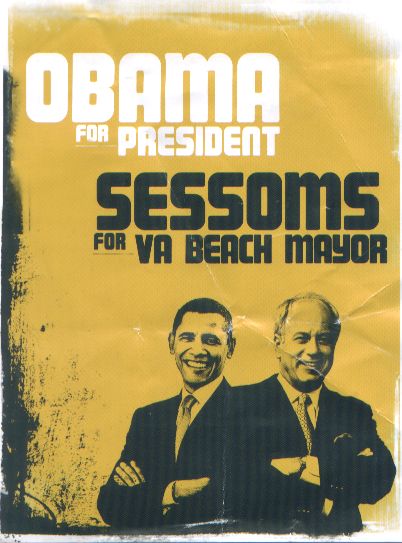
 I actually had something else planned for this part but since Mouse asked, I took a look at the vote information for the last mayoral race in Virginia Beach. That election was held May 4, 2004.
First, as a reminder, here are the figures from the Flier Ticket precincts I discussed in part 1. I have removed all of the data except the figures for the mayoral race.
| # votes | # reg. | Oberndorf | Sessoms | ||
| 5 | Seatack | 1,959 | 3,363 | 564 | 807 |
| 12 | Plaza | 2,147 | 3,485 | 674 | 734 |
| 15 | Old Don | 2,108 | 3,452 | 699 | 722 |
| 50 | Oceana | 1,224 | 2,324 | 330 | 437 |
| 69 | Shell | 1,804 | 2,816 | 649 | 651 |
| 73 | Dahlia | 2,599 | 4,448 | 884 | 958 |
| 76 | Village | 1,623 | 2,812 | 507 | 561 |
| 79 | Pl Hall | 1,618 | 2,467 | 547 | 593 |
| 91 | Lexington | 1,596 | 2,310 | 539 | 582 |
| Totals | 16,678 | 27,477 | 5,393 | 6,045 | |
| % | 60.70% | 47.15% | 52.85% |
And the numbers from the Democratic Ticket precincts from part 2.
| #votes | # reg. | Oberndorf | Sessoms | ||
| 16 | Aragona | 2,696 | 4,299 | 870 | 856 |
| 21 | Davis Crnr | 1,893 | 2,940 | 669 | 658 |
| 29 | Holland | 2,494 | 4,557 | 799 | 797 |
| 36 | Win Oaks | 2,445 | 4,184 | 832 | 818 |
| 41 | College Pk | 1,509 | 2,357 | 660 | 465 |
| 43 | Bellamy | 1,853 | 3,055 | 739 | 588 |
| 45 | Timberlake | 2,039 | 3,155 | 763 | 606 |
| 46 | Green Run | 2,535 | 4,088 | 902 | 772 |
| 54 | Cromwell | 1,313 | 1,925 | 500 | 454 |
| 55 | Mag Hollow | 2,260 | 3,903 | 742 | 741 |
| 61 | Baker | 2,079 | 3,237 | 906 | 695 |
| 71 | Round Hill | 2,775 | 4,478 | 1,051 | 831 |
| 74 | Buckner | 1,752 | 2,865 | 634 | 552 |
| 80 | Reon | 1,309 | 1,998 | 486 | 420 |
| 81 | Rock Lake | 2,074 | 3,246 | 813 | 648 |
| 84 | Tallwood | 2,069 | 2,923 | 796 | 676 |
| 93 | Newtown | 1,223 | 1,852 | 430 | 394 |
| Totals | 34,318 | 55,062 | 12,592 | 10,971 | |
| % | 62.33% | 53.44% | 46.56% |
Here are the figures for the same precincts for the 2004 election which pitted Oberndorf against Robert Dean, using the data available from the VB Registrar’s office (pdf). Note there was a third candidate in the race who received just over 6% of the total votes cast. For purposes of this analysis, I have ignored that candidate.
| # votes | # reg. | Oberndorf | Dean | ||
| 5 | Seatack | 306 | 3,309 | 130 | 146 |
| 12 | Plaza | 547 | 4,029 | 240 | 270 |
| 15 | Old Don | 444 | 3,185 | 170 | 216 |
| 50 | Oceana | 152 | 2,568 | 71 | 69 |
| 69 | Shell | 410 | 2,511 | 241 | 132 |
| 73 | Dahlia | 316 | 3,400 | 153 | 144 |
| 76 | Village | 188 | 2,604 | 78 | 102 |
| 79 | Pl Hall | 195 | 2,232 | 109 | 79 |
| 91 | Lexington | n/a | n/a | n/a | n/a |
| Totals | 2,558 | 23,838 | 1,192 | 1,158 | |
| % | 10.73% | 50.72% | 49.28% |
And
| # votes | # reg. | Oberndorf | Dean | ||
| 16 | Aragona | 469 | 3,976 | 197 | 229 |
| 21 | Davis Crnr | 621 | 4,316 | 345 | 192 |
| 29 | Holland | 350 | 3,969 | 158 | 181 |
| 36 | Win Oaks | 539 | 3,814 | 246 | 250 |
| 41 | College Pk | 313 | 2,111 | 198 | 108 |
| 43 | Bellamy | 204 | 2,572 | 111 | 77 |
| 45 | Timberlake | 240 | 2,714 | 132 | 96 |
| 46 | Green Run | 393 | 3,398 | 201 | 178 |
| 54 | Cromwell | 197 | 1,626 | 98 | 88 |
| 55 | Mag Hollow | 310 | 3,369 | 140 | 158 |
| 61 | Baker | 201 | 4,533 | 124 | 59 |
| 71 | Round Hill | 388 | 3,993 | 214 | 154 |
| 74 | Buckner | 237 | 2,648 | 121 | 102 |
| 80 | Reon | 143 | 1,896 | 88 | 53 |
| 81 | Rock Lake | 280 | 2,867 | 141 | 117 |
| 84 | Tallwood | 335 | 3,192 | 184 | 129 |
| 93 | Newtown | n/a | n/a | n/a | n/a |
| Totals | 5,220 | 50,994 | 2,698 | 2,171 | |
| % | 10.24% | 55.41% | 44.59% |
As I expected, the votes for the May race were significantly less than those this past November, with less than 11% turnout as opposed to more than 60%. It is worth noting that these two groups of precincts, as in 2008, lagged the citywide average turnout, which was 16.71%. Further, note that one precinct in each group did not exist in 2004.
There are a number of ways to adjust the figures for comparison purposes; I chose to apply the 2008 turnout percentages per precinct to the 2004 registered vote totals and then allocated the votes to Oberndorf and Dean based on their actual vote totals in 2004. For example, for Seatack, 1,959/3,363*3309 equals 1,928 total projected votes and 130/(130+146)*1,928 equals 908 votes for Oberndorf and 146/(130+146)*1,928 equals 1,020 for Dean.
| If turnout were same as 2008 | ||||
| # votes | Oberndorf | Dean | ||
| 5 | Seatack | 1,928 | 908 | 1,020 |
| 12 | Plaza | 2,482 | 1,168 | 1,314 |
| 15 | Old Don | 1,945 | 857 | 1,088 |
| 50 | Oceana | 1,353 | 686 | 667 |
| 69 | Shell | 1,609 | 1,040 | 569 |
| 73 | Dahlia | 1,987 | 1,024 | 963 |
| 76 | Village | 1,503 | 651 | 852 |
| 79 | Pl Hall | 1,464 | 849 | 615 |
| 91 | Lexington | n/a | n/a | n/a |
| Totals | 14,271 | 7,183 | 7,088 | |
| % | 59.87% | |||
And
| If turnout were same as 2008 | ||||
| Dem Ticket | # votes | Oberndorf | Dean | |
| 16 | Aragona | 2,493 | 1,153 | 1,340 |
| 21 | Davis Crnr | 2,779 | 1,785 | 994 |
| 29 | Holland | 2,172 | 1,012 | 1,160 |
| 36 | Win Oaks | 2,229 | 1,106 | 1,123 |
| 41 | College Pk | 1,352 | 875 | 477 |
| 43 | Bellamy | 1,560 | 921 | 639 |
| 45 | Timberlake | 1,754 | 1,015 | 739 |
| 46 | Green Run | 2,107 | 1,117 | 990 |
| 54 | Cromwell | 1,109 | 584 | 525 |
| 55 | Mag Hollow | 1,951 | 917 | 1,034 |
| 61 | Baker | 2,911 | 1,972 | 939 |
| 71 | Round Hill | 2,474 | 1,439 | 1,035 |
| 74 | Buckner | 1,619 | 878 | 741 |
| 80 | Reon | 1,242 | 775 | 467 |
| 81 | Rock Lake | 1,832 | 1,001 | 831 |
| 84 | Tallwood | 2,259 | 1,328 | 931 |
| 93 | Newtown | n/a | n/a | n/a |
| Totals | 31,843 | 17,878 | 13,965 | |
| % | 62.44% | |||
Now we can compare the votes Oberndorf actually received in 2008 to what she would have received in 2004 had the turnout per precinct been the same as 2008:
| 2008 act. | 2004 proj | Diff | ||
| 5 | Seatack | 564 | 908 | -344 |
| 12 | Plaza | 674 | 1,168 | -494 |
| 15 | Old Don | 699 | 857 | -158 |
| 50 | Oceana | 330 | 686 | -356 |
| 69 | Shell | 649 | 1,040 | -391 |
| 73 | Dahlia | 884 | 1,024 | -140 |
| 76 | Village | 507 | 651 | -144 |
| 79 | Pl Hall | 547 | 849 | -302 |
| 91 | Lexington | 539 | n/a | n/a |
| Totals | 5,393 | 7,183 | -2,329 |
And
| 2008 act. | 2004 proj | Diff | ||
| 16 | Aragona | 870 | 1,153 | -283 |
| 21 | Davis Crnr | 669 | 1,785 | -1,116 |
| 29 | Holland | 799 | 1,012 | -213 |
| 36 | Win Oaks | 832 | 1,106 | -274 |
| 41 | College Pk | 660 | 875 | -215 |
| 43 | Bellamy | 739 | 921 | -182 |
| 45 | Timberlake | 763 | 1,015 | -252 |
| 46 | Green Run | 902 | 1,117 | -215 |
| 54 | Cromwell | 500 | 584 | -84 |
| 55 | Mag Hollow | 742 | 917 | -175 |
| 61 | Baker | 906 | 1,972 | -1,066 |
| 71 | Round Hill | 1,051 | 1,439 | -388 |
| 74 | Buckner | 634 | 878 | -244 |
| 80 | Reon | 486 | 775 | -289 |
| 81 | Rock Lake | 813 | 1,001 | -188 |
| 84 | Tallwood | 796 | 1,328 | -532 |
| 93 | Newtown | 430 | n/a | n/a |
| Totals | 12,592 | 17,878 | -5,716 |
Note that the difference column does not include the last precinct in each group for which there was no 2004 data.
Now, to be fair, I’m still comparing apples to oranges here. After all, in 2004 there was a third candidate who received about 6% of the overall vote. At the minimum, that would reduce the projected Oberndorf totals. And as I reported in my initial analysis, there were two other candidates in the 2008 race, who combined received more than 25% of the total vote. Who those candidates would have pulled votes from in 2004 would be pure speculation on my part.
So what does all this number crunching show?
In the Flier Ticket precincts, all of which Oberndorf lost in 2008, she won 4 of 8 precincts in 2004, racking up sufficient margins to have won the entire group. In the Democratic Ticket precincts, all of which Oberndorf won in 2008, she won 12 of 16 precincts in 2004, and, as the result, posted an overall win here as well.
Taking the net difference of 8,045 votes (2,329 plus 5,716) and reducing it by 25.65%, the amount that the other candidates received in 2008, still leaves a difference of 5,982 votes, which is pretty close to the 5,000 vote total difference I roughed out in my initial analysis.
 VIVIAN J. PAIGE | All Politics is Local
Beating Robert Dean in May is like an Olympic sport. It happened every 4 years. (96,2000,2004).
Comparing how Meyera did against him to anything else is pretty useless.
Hey, and in 2008 voters were motivated to vote for change. In the Mayor’s office they got one!
OK, here’s another take on the data.
Ignoring the minor candidates, as Vivian does, Oberndorf got 47.15% of the votes and Sessoms got 52.85%. City-wide, the results were 47.59% of Oberndorf and 52.41% for Sessoms. So she fared slightly better in the flier districts than in the city as a whole, but not so well as in what Vivian calls “Democratic districts.”
In 2004, again taking only the numbers for the two major candidates, Oberndorf actually fared WORSE in the “flier districts.” She took 54.05% of the vote city-wide, but only 50.72% of the “flier district” votes.
In the project of the 2004 election to the 2008 turnout, Vivian projected the TOTAL turnout, not just the votes for Oberndorf and Dean. Since in 2004, only 6% of the vote went to other candidates, while nearly 25% did in 2008. Let’s look at Seatack:
However, in 2008, Oberndorf and Sessoms together got 1371 votes, not 1959. Oberndorf got 47.1% of the major-party votes in 2004 (130 out of 276), so that would translate into 695 votes in 2008. The 564 she got is still a 131 vote drop, but not a 344 vote drop.
Seatack is, of course, only one district. In the flier districts as a whole, Oberndorf did WORSE in 2004. To reiterate, Oberndorf got 50.72% of the flier-district major-party votes in 2004, versus 54.09% city-wide — a 3.37% difference. In 2008, however, she got 47.15% of the flier-district major-party votes, versus 47.59% city-wide — only a 0.44% difference.
Sorry, I should have said that Oberndorf fared slightly WORSE than she did city-wide in 2008, not slightly better.
Man, typos all over the place.
For 2004, the second number is correct, Oberndorf got 54.09% of the major-party votes — 20,907 out of 38,653.
How can a flier be illegal? Government can not abridge freedom of speech. Sounds like sour grapes.
And yet another person asks us to explain the sun rising in the east and setting in the west.
MB,
Us guys living in the center get to benefit from both the sunrise and the sunset.
Ackk.
My last reply to MB was not germane to the subject. However it was applicable to a previous, unrelated post by him.
And I could not resist in taking off after the “sun rising in the east and setting in the west” comment.
I apologize for being too ready at the keyboard.
LD: Even wild speculation is preferable to your current state of jumping at a moments notice.
I am sure you have observations that are germane to this subject…like for instance historical insight into other election-related fraud and what the outcome was. Just a suggestion.
Also, it seems like you have a lot to say. Have you considered making a blog of your own? They are free, and can be both endless headaches and/or fun, depending on the day.
Also just a suggestion. You just seem really tense.
It is a simple matter of “Full Disclosure.” The law requires a “Paid for by…” notice on such fliers, and none existed.
I actually took a look at the 2004 projected numbers with 25.65% of the vote allocated to the others and then the remaining votes to Oberndorf/Dean. But in all honesty, I didn’t place any value on the results, mainly because I think (and correct me if I’m wrong), the Moss challenger in 2008 would have taken more votes from Dean than from Oberndorf due to the similarity of their platforms.
But given the different dynamics in the 2004 versus 2008 races, I still think its an apples to oranges comparison.
Or, as Kirwin said, useless.
If Moss took more votes from Dean than from Oberndorf, then her 2004 results in those flier precincts was even worse still, compared to her results in the rest of the city.
Not really. By taking the 25.65% out of the total projected votes, then essentially, you are splitting the difference between the two candidates equally. If, for example, I allocated 75% of the 25.65% to Dean and only 25% to Oberndorf, her numbers are higher.
Like I said, apples and oranges.
I don’t know that there’s a good methodology to use when looking at the old results. The assumption being made is that the segement of the electorate which participated in the may elections is static (that the same people would have turned out and cast votes no matter who was on the ballot–I’m dubious about this) and that the 13% or so of the voters who participated in a May 04 election would have been representative of the entire voting age population of the city–even though it’s a very small self-selecting sample. And few people believe that’s true, it’s why a good number of people wanted to move the municipal elections to November in the first place, to take advantage of increased voter turnout to improve the representativeness of the sample.