
P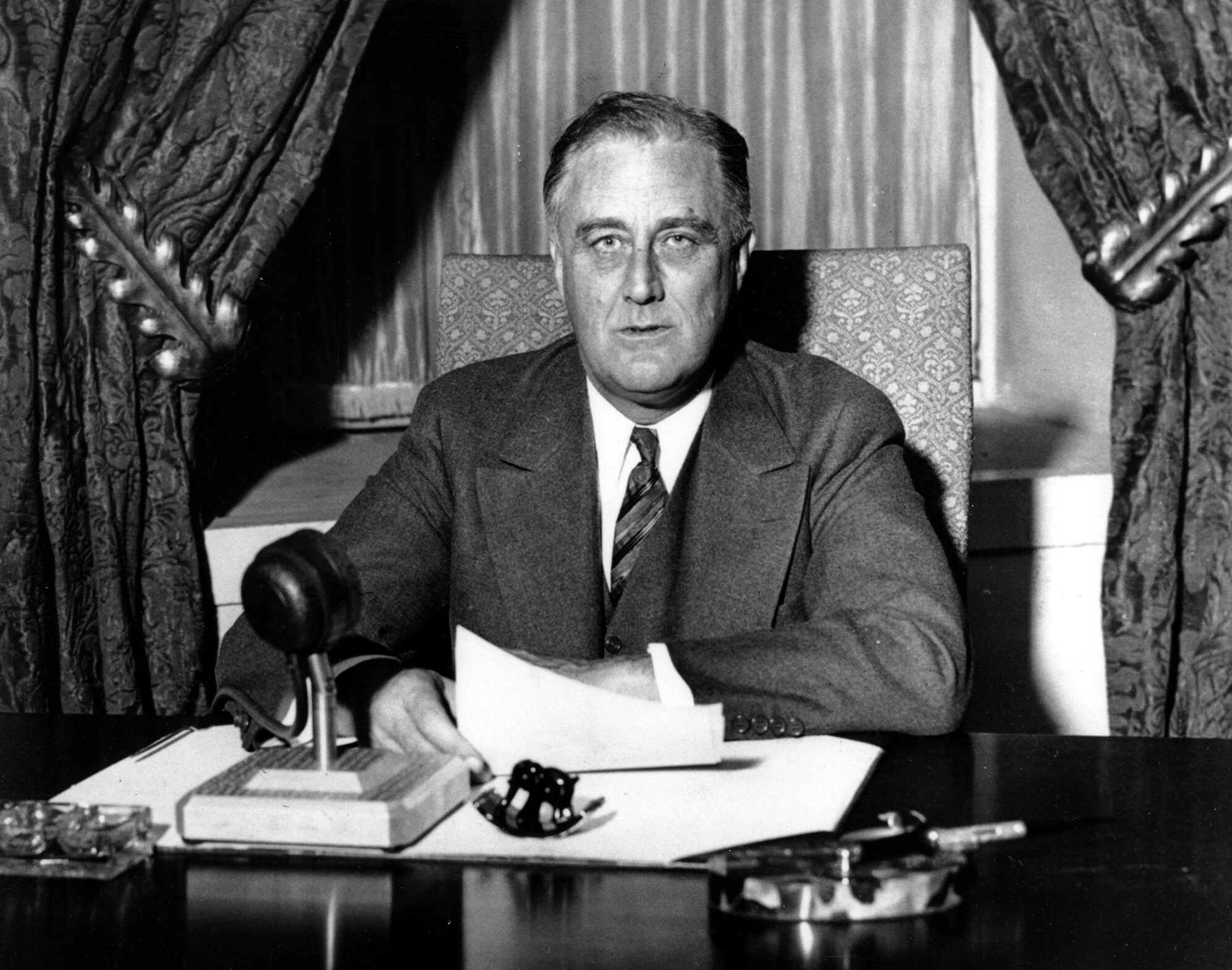 resident Franklin D. Roosevelt, in his January 11, 1944 State of the Union address, put forth a second bill of rights that America should implement. In light of the current conditions in our country, it seems appropriate to revisit FDR’s proposal.
Follow @vpaigeIt is our duty now to begin to lay the plans and determine the strategy for the winning of a lasting peace and the establishment of an American standard of living higher than ever before known. We cannot be content, no matter how high that general standard of living may be, if some fraction of our people—whether it be one-third or one-fifth or one-tenth—is ill-fed, ill-clothed, ill-housed, and insecure.
This Republic had its beginning, and grew to its present strength, under the protection of certain inalienable political rights—among them the right of free speech, free press, free worship, trial by jury, freedom from unreasonable searches and seizures. They were our rights to life and liberty.
As our nation has grown in size and stature, however—as our industrial economy expanded—these political rights proved inadequate to assure us equality in the pursuit of happiness.
We have come to a clear realization of the fact that true individual freedom cannot exist without economic security and independence. “Necessitous men are not free men.”People who are hungry and out of a job are the stuff of which dictatorships are made.
In our day these economic truths have become accepted as self-evident. We have accepted, so to speak, a second Bill of Rights under which a new basis of security and prosperity can be established for all—regardless of station, race, or creed.
Among these are:
The right to a useful and remunerative job in the industries or shops or farms or mines of the nation;
The right to earn enough to provide adequate food and clothing and recreation;
The right of every farmer to raise and sell his products at a return which will give him and his family a decent living;
The right of every businessman, large and small, to trade in an atmosphere of freedom from unfair competition and domination by monopolies at home or abroad;
The right of every family to a decent home;
The right to adequate medical care and the opportunity to achieve and enjoy good health;
The right to adequate protection from the economic fears of old age, sickness, accident, and unemployment;
The right to a good education.
All of these rights spell security. And after this war is won we must be prepared to move forward, in the implementation of these rights, to new goals of human happiness and well-being.
America’s own rightful place in the world depends in large part upon how fully these and similar rights have been carried into practice for all our citizens.
For unless there is security here at home there cannot be lasting peace in the world.
 VIVIAN J. PAIGE | All Politics is Local
These supposed “rights” are “positive rights” which the government cannot possibly provide. The rights in the actual Bill of Rights are all negative rights and the government can always honor them. See http://thenullspace.wordpress.com/2011/07/16/on-rights/ for more details.
I don’t know that FDR was necessarily saying that the government could provide these rights.
Then perhaps you could tell us what he was saying, because if that was NOT what he was saying, then he was just spewing nonsense.
Where does he say that the government was to provide these, James? Or are you just spewing nonsense? He said “We have accepted, so to speak, a second bill of rights…”
By using the phrase “bill of rights” it certainly seems like FDR was saying the government should provide them (either directly by a government entity, or indirectly by enforcement) since the government is obligated to honor the rights listed in the Bill of Rights. If that’s not what he meant, then his use of the phrase “bill of rights” is highly misleading (perhaps purposefully?).
Also, you clearly connected FDRs bill of “rights” to the Bill of Rights by referring to it as a “second bill of rights” that should be “implemented”. Do you think the government should attempt to provide these “rights”?
Do any of you guys do research before attacking the messenger? The term “second bill of rights” was how it has been referred previously. I didn’t make the connection, others did. And the reference is in the speech itself. I didn’t have to make the connection.
And there is a big difference between should provide and could provide.
Finally, think about what shape this country was in in 1944 as compared to today. That was the context in which I posted this.
“And there is a big difference between should provide and could provide.”
Exactly. The Bill of Rights does not say that the government should honor the rights listed in it, but that it can and must honor them. That’s not true of this “second bill of rights” (whether you or FDR or anyone else uses the term). Therefore, the phrase is unnecessarily (and probably intentionally) misleading.
I don’t think we need an economic downturn to understand that the things FDR listed (decent home, good education, useful job, etc.) are good things that we should strive to achieve for everyone. But whether the economy is poor or booming no government can actually provide them for everyone — yet the government would be obligated to provide them if we define them as “rights”.
The problem with such a proposal is that it is SO subjective. What constitutes a “decent home”, “good education”, “adequate food and clothing”, etc.?
We have ways of measuring some of those things, Henry. For example, homes without plumbing would not be considered decent by any measure.
A house without plumbing is a trivial example, but it’s easy to come up with more complicated examples that people would disagree on. Does a “decent” house require a certain amount of floor space per inhabitant? Does a “decent” house require a certain number of bathrooms for a particular number of inhabitants? What if it has hard water and someone else has a home that doesn’t?
People are going to disagree on what constitutes a “decent home” or “useful job” (does a janitorial job for a college graduate count as “useful”?)…so who gets to decide?
Of course it’s trivial by today’s standards. Certainly not the case in 1944.
You guys miss the forest for the trees. You are so busy looking at the specifics of FDR’s proposal that you can’t see the parallels between the economic conditions then and now.
If this list is to be a “second bill of rights” on par with the actual Bill of Rights then we are absolutely correct to closely review the specifics of the proposal. The government would be obligated to provide these things even though it is doomed to fail since they are “positive rights”.
My point about that trivial example is that not all examples are trivial and in many cases there will be major disagreements between whether or not a home (or job, education, etc.) is adequately provided for. So, again, who gets to decide?
I was unaware that the government ever kept anyone from a remunerative job (except by the implementation of Minimum Wage, which makes it illegal for unskilled workers to work).
I was unaware that the government ever kept anyone from owning a decent home, or making enough to feed his family.
I was unaware that the government ever prevented anyone from getting adequate medical care, or prevented him from having good health (with the exception of some experiments on the mentally handicapped).
Of course, restricting the amount of crop a farmer could grow IS a violation of the “right of every farmer to raise and sell his products…”
“The right to a good education.” That’s a tough one. The local government takes your money in the form of property tax, so you cannot afford to send your kids to private school, then says you cannot pick which government school your child can attend. OK, that’s a good one. Time for vouchers.
“The right to adequate protection from the economic fears of old age, sickness, accident, and unemployment.” Well, the threat of confiscating our retirement savings and HSA accounts is certainly there, but it really isn’t a credible threat. And has the government made insurance illegal and I missed it?
Except for the schools, minimum wage, and farm restrictions, the government is not violating any of the above-mentioned rights.
Thank you for posting this Vivian, this message is as timely now as it was then.
Anything the government provides must be taken from someone else. Rights are those things that the government cannot keep from you. You have the right to keep and bear arms; you to not have the right to take someone else’s money so you can buy a gun. You have the right to decent medical care; you do not have the right to take someone else’s money to pay for it.