
Statute of Confederate Soldier Erected in Norfolk
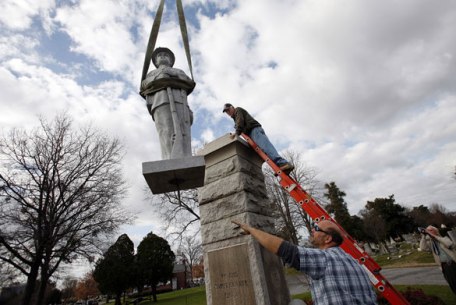
Lee Hart climbs a ladder to position a granite confederate soldier to the base of a monment in Elmwood Cemetery off Princess Anne Road this morning as members of the United Daughters of the Confederacy, Pickett-Buchanan Chapter 21, were on hand to watch the installation. PHOTO BY BILL TIERNAN / THE VIRGINIAN-PILOT
Many of the comments in my earlier post about the proposed resolution apologizing for slavery have a “get over it” kind of attitude. And then I click on PilotOnline and see this. Black folks are supposed to “get over” slavery but white folks are allowed to glorify the Confederacy.
Somehow, I think this is a bit of a double standard. If I need to “get over” slavery (despite the fact that the vestiges of slavery remain), then I think y’all need to “get over” this obsession with the Confederacy.
 VIVIAN J. PAIGE | All Politics is Local
I’m not sure I agree with the resolution to apologize for slavery. However, I don’t have a ‘get over it’ attitude, and I’ve often said that I don’t understand the confederate statues that line Monument Ave. in Richmond. What other country can you go to and find monuments erected to commemorate members of an uprising against the country in which you’re in…it just doesn’t make sense.
Terry – That is like saying democracy does not make sense. The Civil War was the greatest bloodletting the United States ever experience. Yet this civil war was not a war of conquest. Instead, the war freed the slaves and maintained the unity of the nation.
After the war, with one glaring exception, the people in the southern states still maintained their civil rights. Those men who served in the Confederate Army lost their right to vote. That fact, more perhaps than any other, resulted in the period we now call Reconstruction. That period increased the bitterness that resulted from the war.
So we now have statues on Monument Avenue. Like it or not, the rebels fought bravely and honorably. They fought for a poor cause, but they also fought to defend their homes and their fellow citizens. There are worse reasons to honor people.
Citizen Tom, so you’re saying we should erect statues of insurgents in Iraq? Hell, why not erect statues to rebels in Chechnya (sp?) too?
Don’t bite my head. I am a northerner who happens to live down here. Trust me, I KNOW the South lost and love to remind southerners as often as possible.
There ar eno Union Statues in the North… We have the Map of the US as out monument to winning 🙂
The arguments against apologizing for slavery strike me as irrelavent and immaterial to the issue.
As long as prejudice, bigotry, discrimination and their grizzly manifestations such as slavery, ethnic cleansing, and apartheid exist in this world, we should regularly and graciously be apologizing for the suffering we’ve inflicted on one another.
Apologizing, asking for forgiveness, is the moral, decent, and loving thing to do. I can’t think of what possible harm it might do. I can sure think of the benefit!
Saying that those who oppose the resolution have a “get over it” attitude is inaccurately belittling, and beneath you, Viv. The point is not that black Americans should “get over” slavery; the point is that no living American was a perpetrator or victim of slavery. Hence, there is neither wrongdoer to apologize, nor wronged to accept such an apology.
And if, by your reasoning, the Commonwealth should institutionally “apologize” for slavery, when will you demand that the Democrat Party apologize for slavery, secession, and Jim Crow? It is perhaps more responsible for those wrongs than is the Commonwealth as a whole.
That’s not what I said: I said the attitude of the people who commented – of which you were not one – was one of “get over it.” Don’t put words in my mouth.
You are among those that just don’t get it. And I’ve neither the time nor the inclination to argue with the likes of you.
Why not apologize? What’s it going to hurt? What’s the harm? That’s a good rule in life. Apologies are always OK. If more people understood that, the world would be a better place.
Terry, the Confederate Soldiers did not attacks civilians.
One should apologize when one has wronged another. Our legislators did not pass the slavery laws in Virginia, so there is no need for them to apologize for them.
Jack don’t put words in my mouth, I never said they did attack civilians nor did I say that the apology should be issued (nor did I say it SHOULDN’T be issued). I simply said I really have no opinion on this, WHAT I DID SAY WAS I think it’s ridiculous that we still erect statues to a confederate army that tried to overthrow our countries government, I’m sorry that people still don’t get that (I wonder if people realize how RETARDED, yes RETARDED they look flying a confederate flag…)….
As Governor, Mark Warner apologized for Virginia’s participation in eugenics. He said, “We must remember the Commonwealth’s past mistakes in order to prevent them from recurring.”
For similar reasons, an apology for slavery is long overdue. Period.
The Old Soldiers’ Home in Richmond and what we called the Old Ladies’ Home here http://richmondthenandnow.com/Newspaper-Articles/Confederate-Women.html
are where I grew up. I remember some of those cranky old ladies, who must have been daughters of Confederate soldiers. One of my great-great grandmothers lost 9 children during the Civil War because of disease. I am pretty sure that she herself was an immigrant.
That’s just the barest tip of my southern legacy. Those details, including Confederate details, are a part of how I locate myself in this world. But so are the dirt floors of some of my African American neighbors from back then. What really annoys me is this. I’ve been embedded in this culture for a long time and I know it’s racism inside and out. Just as much as I resent the racism in my own culture, I resent having spent a lifetime making my way through it, standing up to it, only to turn around and watch people who know very little about it make authoritative conclusions based on very little information. It happens.
Then just when I want to say something about that, along comes some yahoo and conflates anything Southern with blatant racism.
I cannot get my head around the UDC (and side note – no women are in that photo), but when it comes to the statues on Monument, I see them as much a tribute to the people who put them there – people who were thoroughly defeated and got back up again, took care of the disabled and rebuilt their lives however misguided in their loyalties they may have been. Certainly there were fanatics among them, but the really hard core extremists of that era fled to South America. Much of the dirty post-war work was done by women.
The Arthur Ashe statue is radically different in that it memorializes a pioneer (although Maury was such). But the Ashe statue also represents the people who were dedicated enough to erect it.
I see the monuments more as history from above, constructed by those with money and some time on their hands. What doesn’t receive a fraction of the attention that it deserves is the incredibly rich oral history of both blacks and whites who trace their legacy back to that era. And more than that, the more recent history of the Jim Crow era has been terribly mishandled.
Every person at least my age and above lived in Jim Crow. The small events that we witnessed from time to time were part of it. It’s past time for white people to talk about it in an adult fashion.
It seems to me that some people need to use a dictionary.
APOLOGIZE — acknowledge faults or shortcomings or failing; “I apologized for being late”; “He apologized for the many typos”.
COMMISERATE — to feel or express sorrow or sympathy for; empathize with; pity.
We apologize for our own failings, not the failings of others. As both the people who owned slaves and were slaves are dead, we are well pass the point of an apology. At best, we can commiserate with the descendents of slaves.
Should we feel sorry for the descendents of the slaves? Why? We all are the descendents of slaves, serfs and peasants. Do Blacks have a special need for pity? I don’t think so. Is the idea to make Whites grovel and beg for forgiveness? What a great way to improve race relations! Are suppose to cough up reparations and pay the descendents of slaves to feel good about themselves? Why stop there? Why not have Uncle Sam pay everyone to feel good about themselves?
We remember history so we can avoid the mistakes of those who preceded us. We can try to model the achievements of our forebears and take advantage of the opportunities they have provided us or we can dwell on their failings and suffering. What is the lesson of history? Which behavior do you think will help us to move forward? Should we model the behavior of success or should we cloak ourselves in past miseries?
“The likes of you”!??! Oh, yeah: the rational. Those who understand the language, i.e., the meaning of the word “apologize.” It’s entirely interesting that many of those who don’t understand the word “marriage” will be quick to jump on the bandwagon to issue this meaningless and entirely inappropriate “apology.”
You’re right, Viv: I don’t get it. I also don’t get such a smarmy response to what I intended to be a gentle and respectful chide, but given the fact that you’ve abandoned reason for irrational, baseless emotionalism in order to endorse race-baiting exploitation, it’s not entirely surprising. What is surprising is the fact that you are a member of a political party complicit in the very evils you purport to oppose, and yet don’t demand an “apology” from it..
I don’t get that, either. Nevertheless, given that you apparently can’t have a rational discussion with someone who raises points on this issue you can’t answer, I’m done. WIth “the likes of you.”
Apologize also carries the meaning of expressing regret and acknowledging flaws and offenses. Groups and institutions frequently apologize, e.g., the papal apology for silence during the Holocaust.
This very year we’re celebrating events that took place 400 years ago. Any groveling and begging there? Acknowledgment of past events and errors isn’t about pity at all. It’s about objective honesty about where we come from, which is necessary for moving forward in an authentic way. For those who emphasize the many CW soldiers who didn’t own slaves, who were were protecting their homes and not defending slavery, this should not be a problem.
At one maudlin extreme of regretting past mistakes, the only self-pity for the distant past that I’ve heard in the last several years came from someone whose ancestors lost the family farm for being too nice to their slaves. If that strikes anyone as anecdotal cherry picking, when I leave for work in a few minutes, displays of slave chains will not be reminding me of the past, but a gauntlet of Confederate flags do mark the way.