
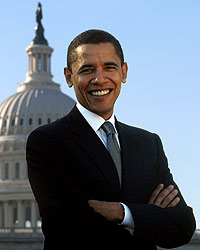
 There is a growing number of people who supported President Barack Obama who are having misgivings about him. One of those is Drew Westen, who penned this rather lengthy editorial for The New York Times. Unlike others who have simply become shrill in their attacks on the president, Westen is thoughtful in his approach, but dead on in his analysis:
The most charitable explanation is that he and his advisers have succumbed to a view of electoral success to which many Democrats succumb — that “centrist” voters like “centrist” politicians. Unfortunately, reality is more complicated. Centrist voters prefer honest politicians who help them solve their problems. A second possibility is that he is simply not up to the task by virtue of his lack of experience and a character defect that might not have been so debilitating at some other time in history. Those of us who were bewitched by his eloquence on the campaign trail chose to ignore some disquieting aspects of his biography: that he had accomplished very little before he ran for president, having never run a business or a state; that he had a singularly unremarkable career as a law professor, publishing nothing in 12 years at the University of Chicago other than an autobiography; and that, before joining the United States Senate, he had voted “present” (instead of “yea” or “nay”) 130 times, sometimes dodging difficult issues.
A somewhat less charitable explanation is that we are a nation that is being held hostage not just by an extremist Republican Party but also by a president who either does not know what he believes or is willing to take whatever position he thinks will lead to his re-election. Perhaps those of us who were so enthralled with the magnificent story he told in “Dreams From My Father” appended a chapter at the end that wasn’t there — the chapter in which he resolves his identity and comes to know who he is and what he believes in.
What Westen and others are waking up to is what writers like those at Black Agenda Report have been saying all along.
Yes, I was a supporter of Hillary Clinton and yes, I was one of her delegates to the Democratic National Convention in 2008. I was one of those who signed the petition to have her name entered into nomination – because she deserved it. And I cast my vote as I had been elected to do: for Clinton.
I took a lot of grief for not being an Obama supporter during the runup to the convention. And the convention was no picnic, either. Let’s just say I have no desire to ever attend one again – unless my preferred candidate is going to win.
Even after the nomination, I had a hard time buying into what Obama was selling. Perhaps if I had been an Obama supporter all along, I would not have looked at him with such a critical eye. I am but a year older than the president, and while his life has been far different from mine, I could find little common ground with him – other than the fact that we happen to both be black.
That is not enough for me.
I can’t say I’m disappointed in President Obama – because that would imply that I had expectations of him in the first place. I didn’t. My disappointment lies with the inability of Democrats – when they had the majorities in both chambers of Congress – to actually do something with them. I was an adult in the Reagan years, so I know what majorities can accomplish. My chance meeting with Shirley Chisolm in October 1981 and what I learned that day has always stayed with me. So my disappointment is with the Democratic leaders in the chambers, those who have been around a long time and didn’t take advantage of the opportunity the voters handed to them.
Yes, I understand that the Blue Dogs often stood in the way. But where are they now? Most of them are gone from the chamber. There had to have been a way to get them to vote certain ways on certain issues – like the public option – instead of letting them control the agenda. (A similar lesson being learned by the Republican leadership in the House and their Tea Party contingent.)
But it is the last line of that quote above – that Obama “comes to know who he is and what he believes in” – is perhaps my biggest problem with him and other candidates. I called out former Rep. Glenn Nye last November for his lack of core values. The difference between Nye and Obama is that the latter is 13 years older, and should be 13 years wiser. I don’t see that in the president.
This is not to say that a President McCain would have been better. That’s an unequivocal no.
But I, like everyone else, knew that the 44th president of the United States was going to face tremendous challenges in this term, challenges so severe that I call them Carter-esque, and that there was a real possibility of this being a single term. All the more reason for the urgency to actually get things done.
I have to admit: I never though the United States would elect Barack Obama. I never thought our country was ready for a black president. And given the thinly veiled – and sometimes, outright – racism that he has faced, sadly it seems I was right about that last part. I have to wonder if some of the resistance from the Blue Dogs was not rooted in that because the big tent of the Democratic Party still counts some racists amount the ranks.
I applaud the president for getting out of bed every morning to just to face the racism, even if it is something he doesn’t acknowledge. I have no doubt it weighs on him.
So my question is not “what happened to Obama” but rather why it took so long for people to realize that this man was not everything people projected him to be.
With the current Republican field being so lackluster, he could be re-elected to another term. And I suspect we will have more of the same.
Unless, President Obama learns who he is and what he believes.


In 2008, 2 months before he won the election, Obama was briefed by DNI McConnell on terrorism threats, something routine for presidential candidates. According to Bob Woodward’s latest book, at the end of the meeting, Obama reportedly said, “You know, I’ve been worried about losing this election. After talking to you guys, I’m worried about winning this election.”
He definitely wasn’t ready to be President and he probably lost his fire for change at that very moment when he realized he would have to spend more time on foreign policy and protecting the country than pushing through his domestic reforms. I definitely agree with you that Obama doesn’t know what he believes.
He had Congress on lockdown and still let Pelosi draft his health care reform bill for the most part. Although really it was lifted almost verbatim from Ezekiel Emmanuel’s book, “Health Care Guaranteed.” His idea of leadership is broad platitudes and letting someone else sort out the details. It is sad though that Republicans and Tea Party types keep calling him a socialist or a communist when he for the most part hasn’t even laid out ideas specific enough to be called either. At least with Bush you knew exactly where he stood and exactly what he was going to do and why.
If you want real change in 2012, Ron Paul is your only choice. I know a lot of Democrats are scared he will destroy social security and medicare because he thinks they are unconstitutional, but he has gone on the record numerous times saying he won’t touch any social programs until he fixes our foreign policy and even then it won’t be for anyone over 40.
Ron Paul stands the proverbial snowball’s chance in getting elected. Here’s as a good an explanation as any as to why any third party candidacy is unlikely.
Ron Paul has a 40 year record of favoring a return to the gold standard, an act of economic insanity that makes the debt ceiling fight pale by comparison. That in itself makes him unfit to be President.
The fact that you think Ron Paul wants to return to the gold standard shows how little you know about his policies. He wants a competing currency system based on mutual credit clearing and backed by a basket of commodities, including but not limited to gold. China, Russia, the IMF, the World Bank, the OPEC countries, and other up and coming economies in Asia all support a move to a new world reserve backed by such a commodity basket, although they don’t want mutual credit clearing because it takes power away from banks and puts it in the hands of individuals.
Mutual credit clearing is essentially what commercial and corporate barter exchanges currently use and the process of credit clearing between banks is what keeps our economy running. A huge percentage of corporate advertising is paid for via mutual credit clearing using barter exchanges whereby excess inventory is monetized into trade dollars and used to purchase television and radio time, billboard space, etc.. We have a company that does this in Hampton Roads called the Barter Authority and they do a ton of business between resort hotels and Sinclair Communications.
http://beyondmoney.net/monographs/credit-clearing-pure-and-simple/
And Vivian, he’s not running as a third party, he’s running as a Republican and the latest Iowa poll has him within the margin of error of third place with half of his people saying there is no chance they will vote for anyone else. He might be un-electable in a general, but he’s got a good shot of winning the nomination. His campaign is by far the most organized this time around. He’s been flying supporters from across the country to attend campaign management schools, founding clubs at colleges across the country, and has more financial support than anyone but Romney. He’s also got the media, for the most part, firmly in his court. Just watch how every news anchor treats him during interviews, it’s extremely reminiscent of how Obama was treated.
http://www.rasmussenreports.com/public_content/politics/elections/election_2012/election_2012_presidential_election/iowa/iowa_caucus_bachmann_romney_and_paul_on_top
Oops, meant to say he’s in third place and within the margin of error of first. He’s also polling in the top 3-4 in most every other early primary state and within the margin of error of beating Obama in a head to head match-up.
Max – RP isn’t going to win the Republican nomination.
Ron Paul will not win the Republican nomination in 2012 any more than he did in 2008. He has a hard core of supporters who will show up and vote for him, but little prospect of expanding beyond that base. I don’t think Romney can win it either. That likely leaves Michele Bachmann and Rick Perry battlling it out. I’d be pretty surprised if either of them can beat Obama. Romney might, but I don’t think he makes it to the general.
Vivian- I have much the same take on Obama that you do. He wasn’t my choise fo the nomination. (I was supporting the guy who couldn’t keep it in his pants). I never thought he was particularly progressive. On domestic issues, I think he was the least progressive of the three candidates. On foreign policy issues, Clinton was to his right.
So I haven’t been too surprised by what he’s done in office.
As far as letting Congress draft the health care reform plan, that’s actually the way the government is suppose dot work. Congress legislates. The president proposes and Congress disposes.
So
Agree on RP.
As for the health care reform – the fact that he took the public option off the table (just as Krugman predicted he would) should have been the wakeup call for most people. He really didn’t do much in the way of proposing anything – at least not until after the legislators came up with something. Certainly not in the mold of, say, LBJ.
Funny you say he won’t win anymore than he would in 2008. The latest Gallup Poll has him in 3rd place nationally, ahead of Bachmann and behind only Perry and Romney. So you can doubt all you want, but all the statistics and polling show him in a solid third and easily within striking distance of first. If he couldn’t expand his base as you say, that wouldn’t be happening. Given the recent downgrade, the further collapse of the dollar, and the continued failing of our foreign policy, he’s only going to poll higher and higher.
Richardson!
No, I meant the other guy who couldn’t keep it in his pants.;-)
Well, I meant that Richardson was the best candidate.
Joke time!
Q: Why would Obama not release his medical records?
A: Because he’d never even run a fever.
If we don’t run someone in a primary(someone good) against Obama a Republican is headed to the White House.Many of my friends will not work for Obama this time around and it will hurt him.
Sammy: Well if Obama was beaten for the nomination, that would also herald a Republican going ot the White House. A party that rejects a sitting president as its nominee is in for the beating it deserves.
No one will challenge Obama for the nomination.
Then the Republicans will take the White House.Obama has over promised and he will pay for it.Hilary could keep the White House under Democrat control.Obama can’t win.
Sammy: I agree with Vivian that no one will challenge Obama. I disagree with you that Clinton could win in 2012. Thinking she would have been the better candidate in 2008 is one thing, that’s debatable. Thinking that a divided Democratic Party that’s overthrown and incumbent president would be in any position to win in 2012 is quite another.
He has a tough re-election hill to climb. He is essentially going to have to rely on Republicans handing him this election. That or an economic miracle between now and then.
On your question, did it really take people that long to realize this though? I think during the campaign he was a blank slate where voters could project any image on him they wanted. He had no record. So he could be anybody, your own living Rorschach test. I think people did lose that false image fairly quickly though. They returned to him a divided legislature full of people who are very much the antithesis of his wishy-washyness.
Yes, I think the hill will be tough to climb. And yes, it appears that it took a lot of people a while to realize it, although not as long as it took the pundits 😉 I think they expected the mid-term losses in 2010 – it is, after all, pretty normal – but were unwilling to look deeper than that.
They weren’t expecting midterm losses of THAT magnitude.
What have they learned from this though? That is the question that bothers me. Was the lesson they should play into this phony argument that we are facing a short-term debt crisis?
TX2- It does seem like the lesson they’ve learned is that they should try to act like Republican Lite. Not sure why they think that will work.